
Mississippi Release Path From Tishomingo
A transfer from Tishomingo County Jail to MDOC ends county jail custody but continues state confinement. The jail out-booking should name MDOC as the destination or receiving authority. Search the Mississippi Department of Corrections after that transfer. A named location or unit supports continued state custody. County of conviction links a sentence to Tishomingo, but it does not mean the person is housed in the county.
No MDOC prison appears within Tishomingo County on the official state facility map. State-sentenced residents may be held at any facility MDOC assigns. When MDOC later reports parole or ERS, the person can be physically in the community while remaining under state authority. Completed discharge is different. It is best shown by a discharge certificate or the actual release or discharge entry.
| Record result | Meaning |
|---|---|
| Named MDOC location | State custody continues at the listed placement. |
| Tentative Release Date | A working forecast, not an accomplished release. |
| Parolees Search match | Community release on active parole supervision. |
| Discharge certificate | Strong proof that state sentence administration ended. |
Search Mississippi Release Records
Open MDOC’s Inmate Search from its home page. Enter an exact MDOC number when known. Name searches are also available, but common names require close comparison. Review date of birth or other identifiers, county of conviction, offense and sentence data, entry date, location, unit, and location-change date before deciding that the result describes the correct person.
- Start with the MDOC number or full legal name.
- Compare the identity fields and Tishomingo county-of-conviction information.
- Read the current location separately from sentence and date fields.
- Quote “Tentative Release Date” with the word tentative intact.
- Use the Parolees Search for claimed parole status.
- Request the actual release or discharge record for retrospective proof.
The inmate search does not cover every Tishomingo County detainee. Someone released locally on bond may never enter MDOC. MDOC also does not promise that all fully discharged former offenders remain searchable with one uniform label. A missing result cannot prove discharge. The county jail record remains necessary for the local custody event.
Mississippi Tentative Release Dates
The public detail labels its forecast “Tentative Release Date.” Older views may use a shorter form, and MDOC’s print warning says state law can cause release types and dates to differ from the website. Sentence administration can change the forecast because of jail credit, consecutive or concurrent terms, eligibility rules, misconduct, forfeited credit, detainers, court amendments, residence approval, or later program decisions.
ERS, tentative release, maximum release, and parole eligibility are separate concepts. An ERS date concerns a possible transition into earned-release supervision. On ERS, the person retains inmate status and remains under MDOC jurisdiction. A tentative date is the working public forecast. A maximum date concerns sentence expiration under the applicable computation. Parole eligibility marks possible consideration, not a promise of release.
- ERS
- Community placement under earned-release rules while MDOC jurisdiction continues.
- Parole eligibility
- The first possible consideration point under the governing rules.
- Tentative date
- A current forecast that can change.
- Actual release
- The recorded event that confinement ended under stated authority.
Mississippi’s earned-time statute and parole rules depend on offense type, sentence date, and eligibility. A universal percentage is unsafe. The official earned-release supervision statute should be read with the person-specific MDOC computation.
Mississippi Release Record Fields
The MDOC public detail can show name, MDOC number, demographic and physical descriptors, entry date, location, unit, location-change date, sentence count, total term, offenses, sentence lengths, county of conviction, sentence dates, a tentative release date, and often an offender photograph. These fields help match a person and understand the sentence. They do not form a discharge certificate.
For an actual release, ask MDOC for an existing release or discharge entry showing the date and authority or type. A discharge certificate is the clearest record of completed discharge when issued. A nonexempt time-computation sheet can explain how credit and sentence structure affected the date. A county jail-credit entry may reconcile an apparent gap between sentencing and MDOC calculations.
MDOC will not create a new report or answer an open-ended research request. Identify the person by MDOC number and list the existing documents sought. Do not promise access to protected field-agent notes, victim information, investigations, or exempt prison information. Ask for severable nonexempt parts if a record contains protected material.
Note: An MDOC photograph belongs to the state record and should not be treated as a Tishomingo jail booking image.
Mississippi Release Records Contact
MDOC Records handles time, jail credit, and eligibility routing, while formal public-record requests go through the Legal Division or online portal. Telephone questions and written records requests are different channels. Use the current MDOC contact page to recheck routing before submission.
MDOC Records Department
P.O. Box 24388
Jackson, MS 39225
Phone: 601-933-2889
Email: MDOCRecordsDepartment@mdoc.state.ms.us
MDOC Public Records Officer
Legal Division
301 North Lamar Street
Jackson, MS 39201
Fax: 601-359-5735
Email: legalpublicrecords@mdoc.state.ms.us
The MDOC online request portal provides request tracking. MDOC policy reports a response period and current copy and labor terms, while a separate administrative rule displays older or different fee figures. Ask which schedule applies, request an estimate, and set a cost limit before work begins.
Mississippi Parole Release Checks
Mississippi separates parole decisions from supervision. The State Parole Board grants, denies, or revokes parole. MDOC Community Corrections supervises parolees. An asserted grant may precede release because plans, detainers, residence review, and administrative prerequisites can remain. The public meeting portal is not a person-specific decision search.
After a claimed grant, search the MDOC Parolees Search. An active match supports community parole but not full discharge. For the governing decision, ask the Board whether it can provide the final action sheet or order. Use the full name, MDOC number, and approximate review month. Do not ask staff to predict a release date.
The Tishomingo Probation & Parole Office is the local Community Corrections point, not a prison. Its listing gives an address and phone but no public reporting hours or walk-in process. A person under supervision should follow the assigned agent’s directions. The Tishomingo post-release supervision page distinguishes parole, probation, ERS, absconder status, and discharge.
Mississippi Release Record Reconciliation
Each agency owns a different event. The Tishomingo County Jail owns its physical out-booking. The court owns the judgment or order. MDOC owns state placement, sentence administration, parole records, and discharge. VINE relays contributor events but does not certify them. Use dates and agency names to build a sequence rather than treating one missing search result as proof.
If Tishomingo says “transferred to MDOC,” pair that out-booking with the first MDOC placement. If MDOC later shows parole, pair the parolee result with the Board action where available. If the person claims full discharge, ask for the discharge certificate or actual discharge entry. A later revocation or new custody event does not erase an earlier valid release. It changes the timeline.
The Tishomingo Sheriff detention page confirms that local staff maintain book-in and book-out records. The Circuit Clerk supplies the court side of the record. Together, these local sources keep an MDOC search tied to the correct Tishomingo case rather than a name-only match.
Mississippi Facility Map Limits
The official MDOC facility map did not identify a state prison inside Tishomingo County. The correct local path is therefore the statewide correctional channel, not a local prison building. Do not publish a street address for a nonexistent Tishomingo state institution or imply that the local Community Corrections office confines people.
The captured MDOC facility map source preserves the statewide facility evidence.
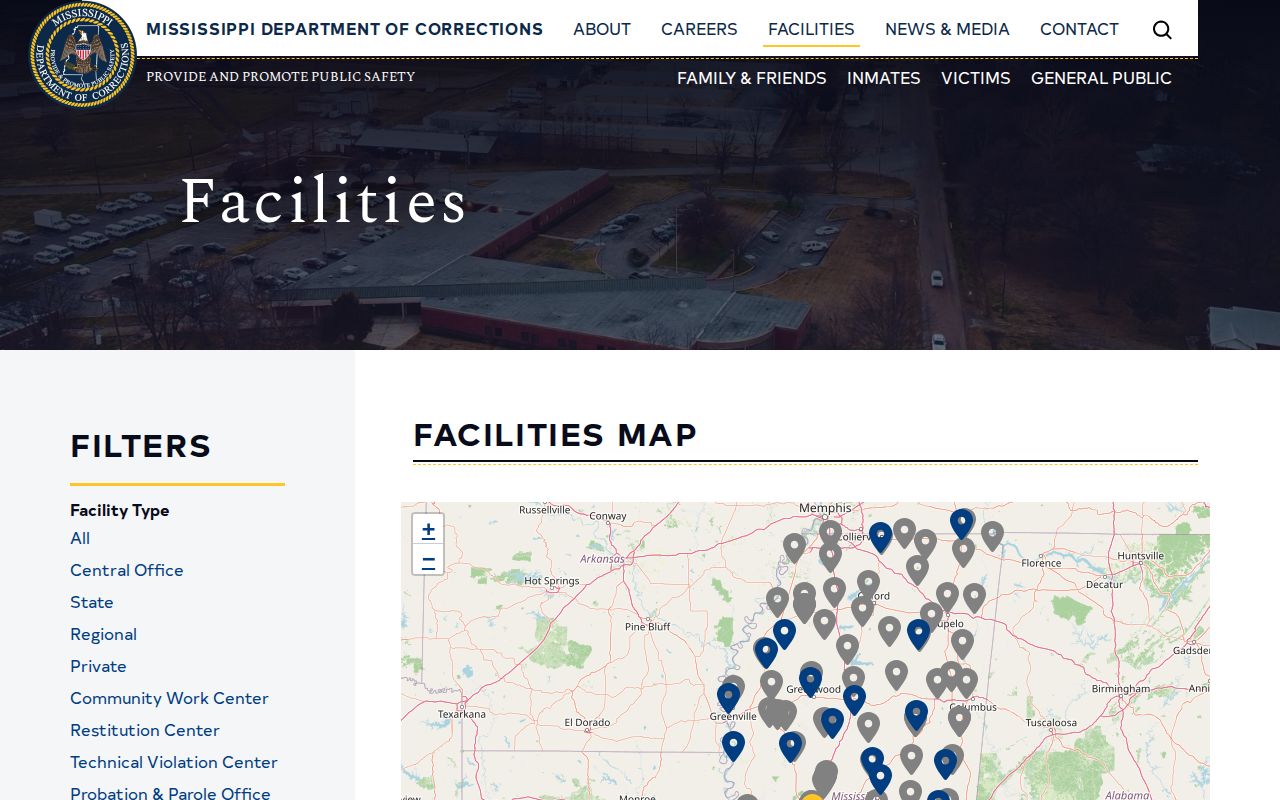
The map helps confirm the absence of a Tishomingo state prison, while each person’s live location must come from the offender record.
A person may move among MDOC facilities. Location-change date is not the same as release date, and a county-of-conviction field is not a housing location. Confirm the live placement directly through MDOC when travel, communication, or legal action depends on it. Facility lists and web labels can change.
When a historical result is missing, ask MDOC Records for the release or discharge entry instead of treating the search gap as proof. Include the MDOC number, the Tishomingo conviction link, and an approximate date. A focused request helps distinguish completed discharge from an interface change, name variation, or record that is not uniformly retained in the public search.
Federal and immigration systems are separate. BOP does not cover an ordinary MDOC sentence, and ICE ODLS does not prove a Mississippi discharge. Use those channels only when the county or state record names that destination. Keeping custody systems separate is the clearest way to avoid a false community-release claim.