
Tishomingo Parole and Probation
Mississippi separates the decision to release a state prisoner from the work of supervising a person in the community. The five-member Mississippi State Parole Board grants, denies, or revokes parole. The Mississippi Department of Corrections Division of Community Corrections supervises parolees, probationers, earned-release supervision participants, and people assigned to intensive supervision. The Tishomingo Probation & Parole Office is part of that supervision system. It is not a jail and does not hold a public list of everyone who has left the county jail.
Parole follows a state prison term and remains conditional until discharge. Probation is imposed by a court and may begin without a prison term or after a short custodial term. Earned-release supervision, commonly called ERS, permits an eligible person to live in the community while still retaining inmate status under MDOC jurisdiction. Those labels matter. A parole search result is not proof of full discharge, while a probation order does not reveal the exact jail out-booking time.
| Status | Who authorizes it | Best verification source |
|---|---|---|
| Parole | Mississippi State Parole Board | MDOC Parolees Search, followed by the Board record when needed |
| Probation | The sentencing court | Judgment or probation order, then MDOC Community Corrections |
| ERS | MDOC under state law | MDOC Records and Community Corrections |
| Discharge | Sentence administration after all required terms end | Discharge certificate or actual MDOC discharge entry |
- Parole
- Conditional community release from state confinement after Board action.
- Probation
- A court-ordered community sentence, sometimes following a period in custody.
- Absconder
- A person reported as having left supervision requirements, not necessarily a person presently in jail.
- Discharge
- The formal end of the sentence or supervision authority documented by the responsible agency.
Verify Tishomingo Post-Release Supervision
Start with the custody path, not just a name. A local bond release may lead to a pending court case without MDOC supervision. A state-prison release may lead to parole or ERS. The public MDOC home page offers an Inmate Search and a separate Parolees Search. The parole tool accepts first name, last name, or MDOC number. Compare identifiers before relying on a match because a common name can return the wrong person.
- Search the MDOC Parolees Search by exact MDOC number when available, or by both names.
- Confirm that the record identifies the correct person. An active match supports community parole, not complete discharge.
- For probation, ERS, intensive supervision, or an unclear status, obtain the sentencing order and contact MDOC Records or Community Corrections.
- Ask for the existing record that states the supervision type, start date, and discharge status. Do not ask staff to predict a release.
- When the question is whether the person physically left Tishomingo County Jail, pair the supervision result with the jail out-booking record.
The MDOC inmate record can still matter after parole because it contains sentence and offense data. Yet its Tentative Release Date is only a forecast. An active parolee record is stronger evidence that the person entered parole in the community. For an actual release or final discharge, request the release entry or certificate. The broader Tishomingo County released-inmate search path explains how to match that state record with the local jail and court files.
Tishomingo Supervision Office Details
The local office provides a county-level contact after parole, probation, ERS, or another MDOC community status. Its official listing supplies an address, telephone, and fax, but it does not publish reporting hours, walk-in rules, or check-in procedures. A person under supervision should follow instructions from the assigned agent. Someone verifying a record should call for the proper channel and should not expect protected field notes or private case details.
Tishomingo Probation & Parole Office1723 West Quitman Street
Iuka, MS 38852
Phone: 662-593-3438
Fax: 662-593-3491
Hours: Not published; call before visiting
The official local-office image from MDOC's Tishomingo listing documents the correct supervision contact rather than a detention site.
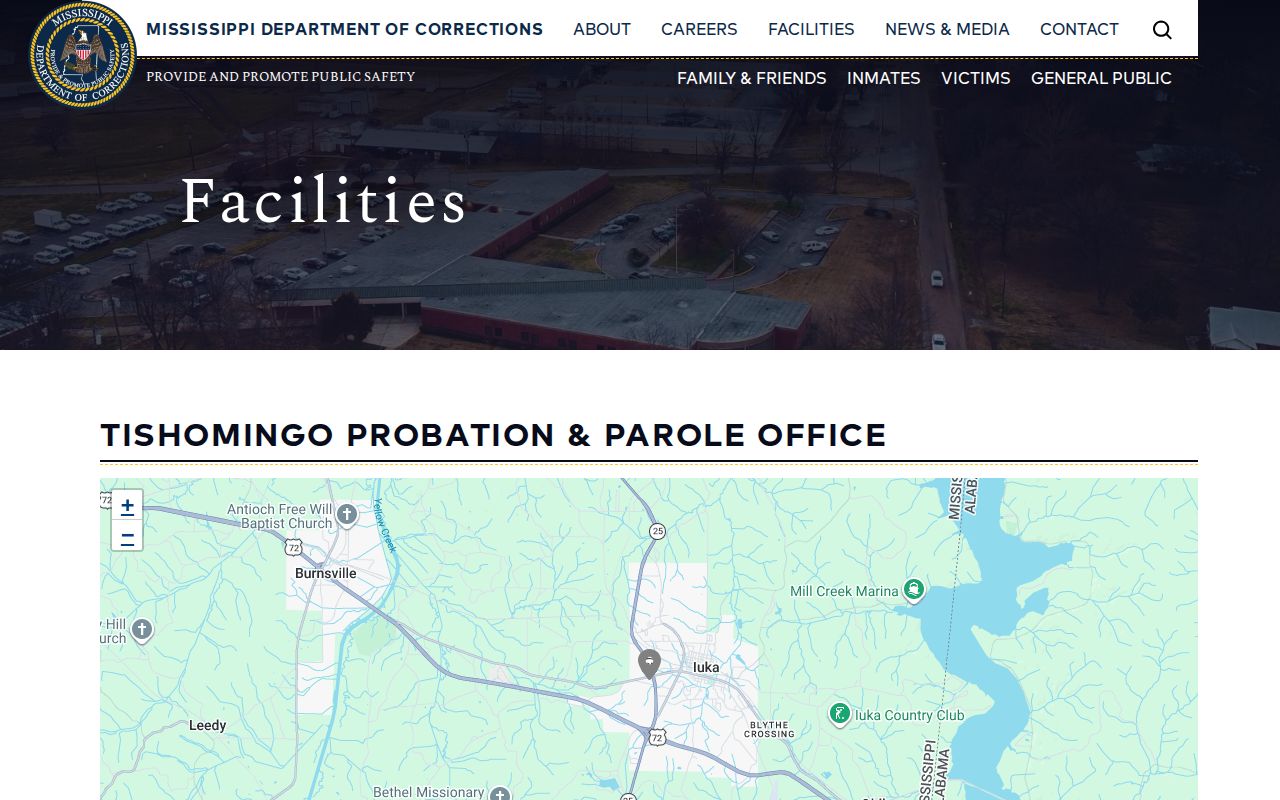
This listing helps route a supervision question, but office involvement alone does not prove that a person has completed or been discharged from supervision.
MDOC Records handles a different task. Questions about time computation, jail credit, and eligibility may be sent to P.O. Box 24388, Jackson, MS 39225, by telephone at 601-933-2889, or by email at MDOCRecordsDepartment@mdoc.state.ms.us. Formal public-record requests must be written and go through MDOC's Legal Division or online request portal. Keeping those routes separate can prevent delay.
Tishomingo Parole Decision Records
Parole eligibility is a point at which consideration may occur. It is not an order to release. Mississippi law uses offense dates, categories, exclusions, and sentence facts to determine eligibility under Miss. Code §47-7-3 and related provisions. Board review may occur by file review, in person, or through a revocation hearing by video or telephone. Outcomes can include grant, denial, continued parole, a technical-violation response, or revocation.
No official public person-by-person hearing calendar or decisions database was located. The state's public meeting notice portal lists public meetings, not individual inmate hearings. To verify a claimed hearing, contact the Parole Board with the full name, MDOC number, and approximate hearing month. Ask whether the Board can confirm that a review occurred and which existing final action sheet or order records the result.
A grant can precede release. MDOC's own material says administrative release processing can take weeks, while plans, detainers, or prerequisites remain. After an asserted grant, look for the person in the Parolees Search and then seek the actual release entry. A denial does not always end eligibility forever, and a revocation can return someone from the community to custody.
Note: Board meeting notices should never be treated as a Tishomingo County parole hearing docket or a source of person-specific outcomes.
Tishomingo Release Warrants and Absconders
A warrant and present custody are separate facts. A person may have left custody lawfully and later face a warrant for an alleged supervision violation or another matter. Likewise, an absconder label means the supervising agency reports that requirements were not followed. It does not prove the person is physically confined at Tishomingo County Jail. Check the current source for each fact rather than merging them.
Supervision conditions come from the court, Board, and assigned agency record. They can concern reporting, approved residence, travel, programs, or other person-specific duties, but a public search result does not disclose the full set. An alleged violation can lead to review, a technical-violation response, continued parole, or revocation. Only the final court or Board action establishes the result. Compare its effective date with any later VINE or jail event so a return to custody is not mistaken for an old release entry.
The Tishomingo County Sheriff's warrant guidance directs warrant questions to the Sheriff's Office and warns the public not to attempt an apprehension. Call 662-423-7000 for nonemergency warrant information and use 911 only for an emergency. MDOC or VINE can show later supervision or custody events, but an automated event should be confirmed with the contributor.
- Ask the Sheriff whether a warrant is current, without approaching the person.
- Check MDOC for parole or another known state supervision status.
- Use Mississippi SAVIN/VINE to watch for an agency-reported custody event.
- Request the court or Board order when the legal basis must be documented.
Tishomingo Supervision Event Alerts
Mississippi SAVIN/VINE reports events supplied by participating county and state agencies. These can include release, transfer, return after absconding, escape, abscond supervision, and rehousing. Tishomingo County Sheriff links the system locally, and MDOC explains its statewide role. A VINE event can alert someone to a change, but it is not a certified parole or probation record.
Anyone may register anonymously through VINELink. General assistance is available around the clock at 1-888-967-7284. When an alert arrives, record the contributing agency, status, and date. Then confirm the event with that agency. Registration Link can continue a notification when a county record moves into MDOC or another participating custody system, which helps distinguish transfer from return to the community.
Tishomingo Supervision Discharge Records
Supervision ends through an official discharge, not merely because a public name is hard to find. The strongest MDOC evidence is a discharge certificate or actual discharge entry. For probation, the court record may include an order ending or modifying the term. A parole record can stop appearing for several reasons, so absence from a live search should be followed by a focused records request.
Ask MDOC for an existing release or discharge entry, the authority and date, and a discharge certificate if issued. Identify the person by MDOC number. If the request involves a court-ordered probation term, request the judgment and later termination or modification order from the responsible court as well. These records answer different parts of the question: the court owns its order, MDOC owns state supervision administration, and the jail owns its physical out-booking.
If a public result is missing, first check the spelling and identifier. Then ask whether the record moved to an archive or whether another office is the custodian. Do not treat a failed search as proof that Tishomingo supervision ended. A dated agency response and the discharge document provide a much sounder conclusion than an empty results screen.