
Tishomingo Tentative and Actual Dates
Mississippi's public MDOC field is called Tentative Release Date. That phrase identifies a working forecast, not an accomplished release. MDOC also calculates earned-release supervision dates and maximum dates for sentence administration. A fourth concept, parole eligibility, marks when Board consideration may occur. These dates answer different questions and should not be used as if they were interchangeable.
An actual release record looks backward. For Tishomingo County Jail, that means the out-booking date, time, disposition, and destination in the jail record. For MDOC, it means the actual release or discharge entry and, when issued, the discharge certificate. Parole and earned-release supervision can put a person outside prison while state jurisdiction continues. Full discharge ends that authority.
A pretrial detainee does not have a sentence-based release date. Bond, dismissal, a release order, case resolution, and unrelated holds can affect when custody ends. The court may explain the legal basis, while jail staff document the physical departure. A county sentence also needs its judgment and local jail calculation because no Tishomingo County jail good-time or weekend-release policy was located.
That source split also applies when a date appears in more than one system. A judge can sign an order before jail staff finish identity checks, other-hold checks, paperwork, and out-processing. Credit for time served may be entered while the court docket remains open. Preserve each date with its label and source. Do not force a court-order date, jail release time, and MDOC forecast into one value.
Find a Tishomingo Release Date
Choose the search route from the custody system. MDOC's Inmate Search covers people in the Mississippi state correctional system and accepts first name, last name, or MDOC number. It does not cover every person booked at Tishomingo County Jail. Someone released locally on bond may never enter MDOC data. A county-of-conviction value of Tishomingo links the sentence to the county, but the current location can be elsewhere in Mississippi.
- Identify whether the person is in county, state, federal, or another custody system.
- For MDOC custody, open the MDOC Inmate Search and use the exact MDOC number when known.
- Compare name, county of conviction, sentence, entry date, and current location before reading the Tentative Release Date.
- For Tishomingo County Jail, call 662-423-7000 and ask whether there is a sentence-based date, bond status, court action, or another hold.
- Obtain the sentencing order from the responsible court and request the jail or MDOC computation when the date needs to be explained.
- After release, request the actual out-booking or release and discharge entry instead of relying on the earlier forecast.
The official MDOC offender detail illustrates the state fields used for a release date lookup.
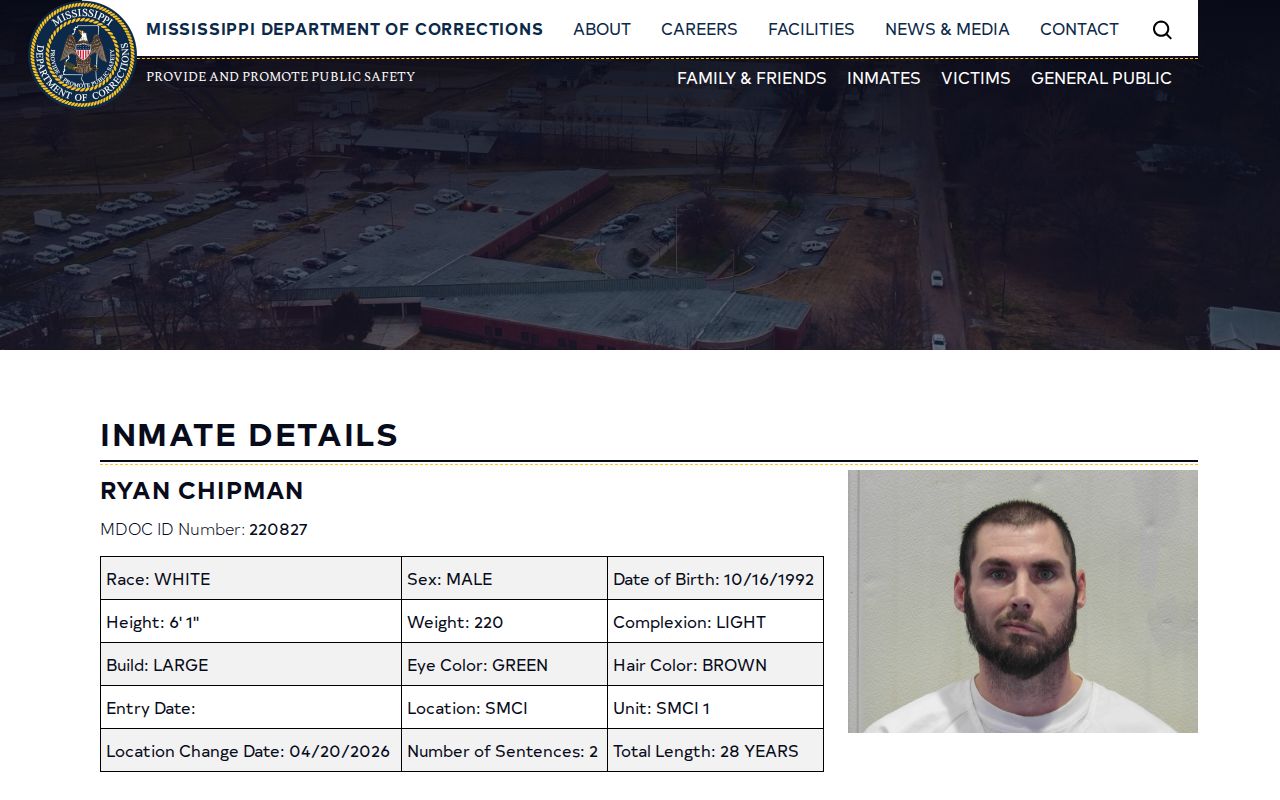
The detail includes sentence and location context around the tentative date, so identity and custody status can be checked before the date is recorded.
MDOC public detail can also show name, MDOC number, entry date, unit, offenses, sentence lengths, county of conviction, and an offender image. An entry date or location-change date is not a release date. If no result appears, do not assume discharge. MDOC does not promise that every fully discharged former offender stays searchable with one uniform status.
A Tishomingo County Jail call answers a narrower operational question. Give the full name, approximate booking date, and a second identifier. Ask whether the person is presently held. If not, ask for the most recent out-booking date and whether the disposition was bond, court order, community release, or transfer. A telephone response is useful confirmation, but it is not a certified record. Request the booking sheet or jail-docket entry when the date will be cited in a court or records matter.
Tishomingo Release Date Labels
The label attached to a date determines what it can prove. MDOC administers several timing concepts, and each may move for a different reason. Reading only the number can produce a false claim about when someone will leave confinement or when supervision ends.
| Date concept | What it means | What it does not prove |
|---|---|---|
| ERS date | Possible move into earned-release supervision after required review | Full discharge or an automatic community release |
| Tentative Release Date | MDOC's public working forecast for sentence administration | The final release type or completed event |
| Maximum date | Sentence expiration under the applicable official computation | A date that should be reconstructed from memory when absent |
| Parole eligibility date | Earliest possible consideration point under governing rules | A parole grant or physical release date |
ERS leaves the person under MDOC jurisdiction and with inmate status until sentence expiration. Conduct and the proposed residence can affect approval. A violation can lead to return to confinement. Parole is separate because the State Parole Board acts on eligibility and release. Discharge is separate again because it documents the end of sentence administration.
For a transfer from Tishomingo County Jail to MDOC, the county out-booking date and state entry date describe movement between custodians. Neither should be called a release to the community. Search the receiving MDOC location, then use the tentative field only for the later state-sentence forecast. If the destination is another county, a federal authority, or ICE, confirm the next custody record in that agency's system.
Tishomingo Earned-Time Release Rules
Miss. Code §47-5-138 is the source of the common 85 percent shorthand, but that phrase is not a universal release calculator. For an eligible sentence imposed for an offense after June 30, 1995, the law permits up to 4.5 days of earned allowance for each 30 days served, capped at 15 percent of the sentence. Release under that provision is earned-release supervision. It does not amount to unconditional freedom or final discharge.
Eligibility exclusions and delays can apply. Life sentences, habitual status, certain sex offenses, escape, mandatory time, detainers, and other legal conditions may prevent or postpone the credit. Earned credit can also be forfeited. The official §47-5-138 earned-release supervision text should be read with the current sentence and offense facts.
Section 47-7-3.2 adds minimum service rules for newer crimes. Its categories generally use 25 percent or ten years for nonviolent offenses, 50 percent or twenty years for violent offenses, and 60 percent or twenty-five years for specified armed robbery, drive-by shooting, and carjacking offenses, subject to the statute's exact terms. Parole eligibility under §47-7-3 is yet another calculation. Offense category, date, and exclusions can control, so a date should never be promised from simple subtraction.
Note: Tishomingo County has no researched local jail good-time formula, so obtain the sentencing order and the jail's own calculation.
Why Tishomingo Release Dates Change
MDOC uses the full sentence record, not just the sentence length printed on a judgment. County jail credit may move the sentence-begin date. Concurrent terms run together in a defined way, while consecutive terms run one after another. Later court amendments, new records, and sentence classifications can also change the public forecast.
| Factor | Possible effect on the release date | Record to check |
|---|---|---|
| County jail credit | Moves the credited start calculation when allowed | Jail-credit entry and time-computation sheet |
| Concurrent or consecutive terms | Changes how multiple sentences combine | Judgments and MDOC computation |
| Credit forfeiture or conduct | Can delay an earned-time result | Nonexempt computation and credit record |
| Detainer or hold | Can block community release or lead to transfer | Hold and receiving-agency record |
| Residence or program approval | Can affect an ERS or parole transition | Official MDOC or Board action |
| Court amendment | Can alter sentence terms or credit | Amended order and recalculation |
A detainer is a request by another authority to hold or receive a person. If Tishomingo County releases someone to MDOC, another county, a federal agency, or ICE, physical custody has continued elsewhere. A changed destination can explain why a forecast did not lead to community release on the expected day.
Mississippi's Tentative Release Warning
The state's own wording is a key local accuracy rule. MDOC calls the public field Tentative Release Date, while separately calculating ERS and maximum dates. Its print record warns that state law can cause the release type and date to differ from what appears online. That warning should travel with any copied date.
The MDOC supervision-types page provides the distinctions behind ERS and other calculated dates.
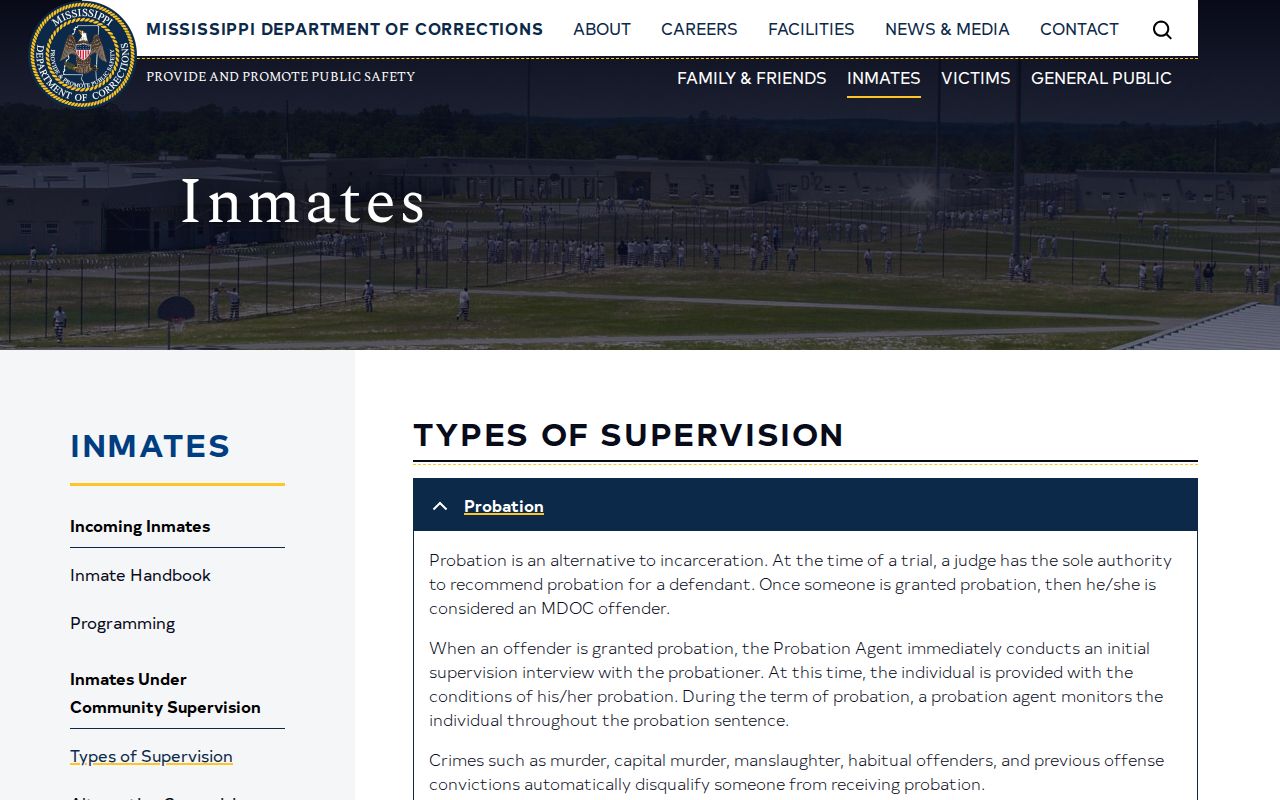
The state description makes clear that a move into community supervision can still leave the person under MDOC authority.
When preserving a result, record the date viewed, the exact field label, the MDOC number, and the custody location. Do not rename the field “confirmed release date.” If the release later occurs under a different type or on a different day, the actual release entry controls.
Confirm Tishomingo Release Dates
MDOC Records can provide the existing nonexempt time-computation sheet, county jail-credit record, actual release or discharge entry, and discharge certificate. Use the MDOC number and name, ask for electronic copies, request severable portions if anything is withheld, and seek a cost estimate before processing. Time and jail-credit routing questions can go to MDOC Records at P.O. Box 24388, Jackson, MS 39225, 601-933-2889, or MDOCRecordsDepartment@mdoc.state.ms.us. Formal public-record requests go to the Legal Division or MDOC portal.
A focused written request should name existing records rather than ask staff to calculate a new release day. Request the current nonexempt time-computation sheet, county jail-credit entry, and actual release or discharge entry when it exists. The computation explains how credit and sentence structure affected the forecast. The later entry establishes what occurred. If a record is withheld in part, request redaction and production of the rest with the cited exemption.
For local custody, call Tishomingo County Jail at 662-423-7000. Ask whether the person is currently held and, if not, whether staff can provide the out-booking date, time, type, and destination. Follow a telephone answer with a written request when documentary proof matters. A court order may explain the legal authority, but it may be signed before jail staff complete the physical release steps.
Record when each source was checked. Search labels, custody locations, credits, and court orders can change after an earlier screenshot. A dated capture shows what the forecast said then, while the later agency record shows how the Tishomingo County release actually occurred.
Mississippi SAVIN/VINE can send a pending event alert, although it does not certify the date. Registration and identity-matching details are covered in the VINE Inmate Check. Confirm each alert with the source agency, especially if another active record suggests a transfer.